

P0740 on 2000-2005 Toyota RAV4: Torque Converter & ECM Failure Guide
On a 2000-2005 RAV4, P0740 is often caused by a failing Engine Control Module (ECM) that damages the transmission, not just a bad solenoid. Expect to repair or replace the ECM to fix the issue permanently, which can cost several hundred dollars for a repair service or over a thousand for a new OEM unit.
- Code P0740 on a 2000-2005 RAV4 is a serious issue that points beyond a simple solenoid problem.
- The most likely cause is a failing Engine Control Module (ECM), a known weak point on this vehicle generation.
- Do not replace the transmission or solenoids without first ruling out a faulty ECM, as the problem will likely recur.
- Symptoms include harsh, jerky shifting and a lit Check Engine Light.
- Due to the complexity of diagnosing the ECM and working on internal transmission components, professional service is strongly recommended.
What's Unique About the 2000-2005 Toyota RAV4
For the 2000-2005 (XA20 generation) RAV4, code P0740 is very frequently a symptom of a much larger, well-documented problem: Engine Control Module (ECM) failure. The original ECMs in these vehicles are known to fail internally due to manufacturing defects, sending erratic or incomplete signals to the transmission solenoids. This not only causes harsh, banging shifts and sets codes like P0740, P0750, P0753, P0755, and P0758, but it can also lead to permanent physical damage to the transmission if not addressed promptly. Simply replacing the TCC solenoid or the transmission will not solve the problem if the root cause is the faulty ECM.
Symptoms You May Notice
- Check Engine Light is on
- Harsh or jerky shifting, especially a bang or flare on the 2-3 upshift.
- Slamming into gear when selecting Reverse.
- Engine RPMs are higher than normal at highway speeds (due to no TCC lockup)
- Reduced fuel economy.
- Vehicle feels like it's slipping or shuddering at highway speeds.
- Stalling when coming to a stop.
- Vehicle feels like the brakes are engaging by themselves.
- Delayed acceleration, which can make the vehicle feel unsafe when pulling into traffic or intersections (as noted in a similar Toyota drivetrain report, NHTSA ODI #11712764).
- Replacing the transmission without addressing the faulty ECM. If the ECM is the root cause, the new transmission will soon exhibit the same problems and may be damaged.
- Replacing only the TCC solenoid when the ECM is the actual cause of the electrical fault. This will not fix the harsh shifting or prevent other solenoid codes from appearing.
- Assuming the transmission is mechanically failed due to the violent shifting, when it is only a symptom of the bad computer signals.
Most Likely Causes
- Failing Engine Control Module (ECM) 🔴 High Probability → Shop Engine Control Module (ECM) A widespread, well-documented failure on 2001-2005 models where the ECM's internal solenoid drivers fail, sending improper signals. Toyota acknowledged this with TSB TC002-06, later superseded by T-SB-0156-10, and a warranty extension for 2001-2003 models. The issue is also prevalent on 2004-2005 models, though they were not included in the original warranty extension.
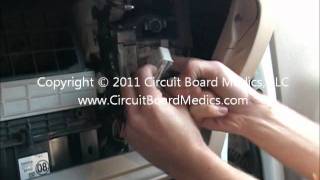
How to confirm: Often diagnosed by exclusion after solenoids and wiring test good. The presence of harsh shifting and a combination of transmission codes (P0740, P0750, P0753, P0755, P0758) strongly points to the ECM. The problem is so common that specialized companies like Circuit Board Medics and UpFix offer dedicated repair services. 🎬 Watch: How to diagnose and repair a faulty RAV4 ECM
Typical fix: The ECM must be repaired by a specialist service or replaced with a new or remanufactured unit. After replacement, the transmission should be inspected for damage and the codes cleared. A road test of at least 20 minutes is needed to complete the ECM learning function.
Est. part cost: $150-$250 for a repair service, $400-$1200 for a replacement unit. - Failed Torque Converter Clutch (TCC) Solenoid 🟡 Medium Probability → Shop Automatic Transmission Torque Converter While less common than the ECM failure on this platform, the solenoid can still fail electrically or become clogged with debris, especially if the fluid is dirty or the transmission has been damaged by a faulty ECM.
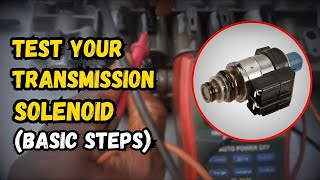
How to confirm: Requires dropping the transmission pan to access the solenoid. A multimeter is used to test the solenoid's resistance against the manufacturer's specification (e.g., a spec for the TCC solenoid, also called DSL, is 11-13 ohms). A scan tool can also be used to command the solenoid on/off to check for a response.
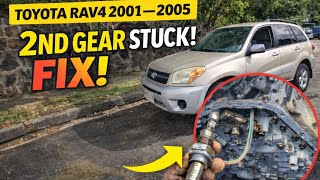
Typical fix: Replace the faulty TCC solenoid (often called Shift Solenoid SL or DSL on these Toyotas) and the transmission pan gasket. Refill with the correct type of fluid.
Est. part cost: $150-$300 - Low or Dirty Transmission Fluid ⚪ Low Probability → Shop Transmission Assembly
How to confirm: Check the transmission fluid dipstick for level and inspect the fluid's color and smell. It should be bright red and not smell burnt. Dark, brown, or burnt-smelling fluid indicates internal wear or overheating.
Typical fix: Perform a transmission fluid drain-and-fill or flush using Toyota Type T-IV compatible fluid. If the fluid is very dirty or contains metal particles, the filter should also be replaced, and further diagnosis for internal damage is needed.
Est. part cost: $50-$150 for fluid and filter.
Rare But Worth Checking
- Damaged Wiring or Connectors: The wiring harness leading to the transmission can become damaged from heat, vibration, or road debris. A visual inspection of the harness and connectors for corrosion or breaks is a necessary diagnostic step. NHTSA ODI #11709274 illustrates a case where P0740 appeared alongside multiple pressure control solenoid and sensor codes, suggesting a broader electrical or circuit issue.
- Internal Torque Converter Failure: → Shop Automatic Transmission Torque Converter The mechanical clutch inside the torque converter itself can wear out, especially if subjected to prolonged harsh engagement signals from a faulty ECM. This is a major repair that requires removing the transmission from the vehicle.
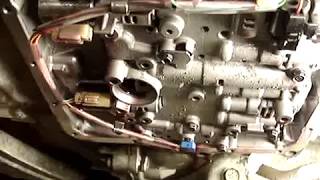
- Clogged Valve Body Passages: → Shop Transmission Valve Body Debris from normal wear or component failure can clog the small hydraulic passages within the valve body, preventing the TCC solenoid from operating the clutch correctly. This often requires removing and cleaning or replacing the valve body. 🎬 Watch: Step-by-step RAV4 valve body replacement guide
Diagnosis Steps
- Check and document any other stored trouble codes. The presence of other solenoid codes (P0750, P0753, P0755, P0758, P1760) is a major clue pointing to ECM failure.
- Check the transmission fluid level and condition. Address any low fluid or very dirty fluid first.
- Inspect the external wiring harness and connectors going to the transmission for any visible damage, corrosion, or loose connections.
- If possible, use an advanced scan tool (like Toyota Techstream) to perform an Active Test, commanding the TCC solenoid on and off to check for a response.
- If wiring and fluid are good, test the TCC solenoid itself. This requires removing the transmission pan. Test the solenoid's resistance with a multimeter. The TCC/DSL solenoid should be 11-13 ohms, while shift solenoids A/B (SL1/SL2) are typically 11-15 ohms.
- If the solenoid tests good, the wiring is intact, and the fluid is clean, the ECM is the most likely cause of the problem, especially if harsh shifting is a primary symptom.
Parts You'll Likely Need
- Engine Control Module (ECM)
(OEM #89661-42650, 89661-42651, 89661-42652, 89661-42660, 89661-42661, 89661-42810, 89661-42821 (Partial list, many others exist).)— This is the most probable root cause for P0740 and related transmission issues on the 2001-2005 RAV4.
Trusted brands: Toyota (OEM New or Reman), Circuit Board Medics (Repair Service), UpFix (Repair Service), Flagship One (Programmed Replacement)
OEM price range: $1000+
Aftermarket price range: $150-$500 (Repair/Exchange) - Torque Converter Clutch (TCC) Solenoid — This is the component directly identified by the code's definition and can fail, though it's less likely than the ECM on this vehicle.
Trusted brands: Aisin, Rostra, WVE
OEM price range: $200-$350
Aftermarket price range: $100-$200 - Automatic Transmission Fluid (Toyota Type T-IV)
(OEM #00279-000T4)— Required when replacing the solenoid or servicing the transmission. Using the correct fluid is critical for Toyota transmissions.
Trusted brands: Toyota, Idemitsu (TLS), Aisin (T-IV)
OEM price range: $10-$15 per quart
Aftermarket price range: $8-$12 per quart
Related Codes That Often Appear With This One
- P0750 — Shift Solenoid 'A' Malfunction. Often set alongside P0740 due to the common ECM failure affecting multiple solenoid circuits.
- P0753 — Shift Solenoid 'A' Electrical. Another code pointing to an electrical fault in the transmission control system, frequently caused by the failing ECM.
- P0755 — Shift Solenoid 'B' Malfunction. Like the others, this code is a strong indicator of the underlying ECM issue on this specific RAV4 generation.
- P0758 — Shift Solenoid 'B' Electrical. Points to an electrical issue with another shift solenoid, reinforcing the diagnosis of a systemic electrical problem, likely from the ECM.
- P1760 — Shift Solenoid (SLT) Linear Circuit Malfunction. Also listed in Toyota's TSB as a code related to the ECM failure.
Technical Service Bulletins (TSBs) & Recalls
- T-SB-0156-10 (Supersedes TC002-06): Addresses harsh shifting and MIL ON with codes P0750, P0753, P0755, P0758, and/or P1760 for 2001-2003 RAV4s. It identifies an improved ECM as the primary fix and notes that in some cases, the transaxle assembly may also require replacement if it has been damaged.
- TC002-06: The original TSB for the harsh shifting/ECM issue, later replaced by T-SB-0156-10.
Platform-Specific Known Issues
- A widespread, well-documented failure of the Engine Control Module (ECM) on 2001-2005 models causes erratic transmission behavior, including harsh shifting and setting various solenoid codes like P0740. Toyota issued a warranty enhancement and TSB (T-SB-0156-10, which supersedes TC002-06) related to this issue for 2001-2003 models, acknowledging the problem. Failure to replace or repair the faulty ECM will likely lead to the same symptoms returning and can cause permanent damage to a new or rebuilt transmission.
Mechanic-Grade Diagnostic Values
- TCC Solenoid (DSL) Resistance — expected: 11 to 13 Ω at 68°F (20°C). Failure: A reading outside of this range indicates an electrical failure in the solenoid coil.
- Shift Solenoid 'B' (SL2) Resistance — expected: 11 to 15 ohms. Failure: A reading outside of this range points to a faulty solenoid coil. This is useful when multiple solenoid codes are present.
- Shift Solenoid SL1/SL2 Voltage Drop (During 1-2 Shift) — expected: Voltage should drop from 5-6 volts to 0 volts in less than 0.5 seconds.. Failure: A slow or incomplete voltage drop can indicate a sluggish solenoid or a problem with the ECM driver circuit.
Scan Tool Commands That Help
- Toyota Techstream: Active Test for Solenoids (e.g., Shift Solenoid SL, Lock-Up) — This command allows a technician to manually turn the TCC solenoid on and off while monitoring the circuit. It helps isolate whether the fault is with the solenoid itself or the controlling ECM, without having to first remove the transmission pan.
- N/A - Procedure: ECM Learning Function — After replacing the ECM, the vehicle must be driven under normal city conditions for at least 20 minutes. This allows the new ECM to learn the transmission's characteristics and ensure smooth shifting. Skipping this can lead to continued poor shift quality even with a good ECM.
Wiring & Ground Locations
- Engine Control Module (ECM) — Behind the glove compartment on the passenger side of the dashboard.. This is the most common point of failure. Access is required for inspection, testing of pins, and replacement. Removal involves detaching the glove box and side trim panels.
- Transmission Case Connector (U140F) — On the top/side of the automatic transaxle assembly.. This is where the main vehicle harness connects to the internal transmission wiring. Pin 8 is for the TCC/Lockup Solenoid (DSL). This allows for testing the solenoid and wiring from outside the transmission.
- Engine Compartment Ground Points — Key grounds are located on the valve cover going to the frame near the strut tower, and a large ground from the top of the transmission to the frame near the motor mount.. A poor ground connection for the ECM or transmission can cause erratic electrical behavior, mimicking a component failure. Verifying these grounds are clean and tight is a crucial early diagnostic step.
Real Owner Repair Stories
- Composite of multiple TSBs and repair shop articles (2001-2005 Toyota RAV4 (2WD or 4WD)) — Check Engine Light with code P0740, often accompanied by P0750, P0753, P0755, P0758. Extremely harsh, banging shifts, particularly from 1-2 and 2-3. Vehicle may feel like it's being hit from behind when it shifts.
❌ Tried (didn't work) Replacing the TCC solenoid and transmission filter/fluid. The problem would return almost immediately., Clearing the codes, only to have them reappear on the next drive cycle., Replacing the entire transmission without addressing the ECM. The new transmission would quickly develop the same harsh shifting and codes.
✅ What actually fixed it The definitive fix was either repairing the original ECM through a specialist service (like Circuit Board Medics or UpFix) or replacing the ECM with an updated part number from Toyota. The root cause was an internal manufacturing defect in the original ECM that caused its solenoid driver circuits to fail. - NHTSA ODI #11712764 — An owner reported that the vehicle felt unsafe when pulling into traffic due to delayed acceleration. Diagnostic trouble codes retrieved included P0740 (Torque Converter Clutch Actuator Stuck On) and P0745.
"I Checked Everything" — The Actual Cause
- The electrical equivalent of a 'smoke test clean' scenario is very common for this code. Technicians will remove the transmission pan, test the TCC solenoid's resistance, and find it is within the correct spec (e.g., 11-13 ohms). They will test the wiring from the transmission connector to the ECM and find no shorts or opens. Despite all components testing 'good' individually, the code and harsh shifting persist. The actual cause is the internal failure of the ECM's logic or driver circuits, which cannot be diagnosed with a simple multimeter test and requires either replacement or specialized board-level repair.
OEM Part Supersession History
89661-42650→89661-42651, 89661-42652, 89661-42653, 89661-42654, then kit 04009-41242. Also superseded by 89661-42812 in some applications.— To correct the internal manufacturing defect that caused solenoid driver failure and harsh shifting.
Heads up: Part numbers are specific to 2WD vs 4WD and model year. It is critical to match the part number from the original ECM or use a VIN-lookup to get the correct, currently available replacement part. Using the wrong part number can result in a no-start condition or continued transmission issues.89661-42660→89661-42661, 89661-42662, 89661-42663, 89661-42664, then kit 04009-41342.— Correction of the same internal ECM defect for a different vehicle configuration (e.g., 4WD vs 2WD).
Model Year Variations Within This Range
- 2001-2003: These model years were covered by Toyota's warranty enhancement program (10 years/150,000 miles for the ECM/transmission) and TSB T-SB-0156-10, which acknowledged the ECM defect.
- 2004-2005: These models are also known to suffer from the same ECM failure mode, causing identical symptoms. However, they were NOT included in the official warranty enhancement program. Owners of these vehicles must pay for the repair out-of-pocket. These years also featured the larger 2.4L 2AZ-FE engine, requiring different ECM part numbers than the 2001-2003 2.0L 1AZ-FE models.
- 2000-2005: The vehicle was available in Front-Wheel Drive (FWD) with the U241E transmission and All-Wheel Drive (AWD) with the U140F transmission. While the ECM issue is common to both, parts like the transmission itself, filter, and some ECMs are specific to the drivetrain.
Diagnostic Flowchart
Other Known Issues on This Vehicle
Issues unrelated to this code that are worth knowing about as an owner of this generation:
- Excessive Oil Consumption (2.4L 2AZ-FE Engine) 🔴 High — Common on 2004-2005 models with the 2.4L engine, often starting around 70k-100k miles. Can consume over 1 quart per 1,000 miles. (Ref: A later warranty enhancement program (ZE7) covered 2006-2011 models for this issue, but not the 2004-2005 RAV4, despite having the same root cause (defective piston rings).)
- Stripped Cylinder Head Bolt Threads (2.4L 2AZ-FE Engine) 🔴 High — A known design flaw where the rear head bolts can pull the threads out of the engine block, causing a head gasket leak and overheating. Often occurs between 100k-150k miles.
- Oxygen (O2) Sensor Failure 🟡 Low — Fairly common for the heated oxygen sensors (both upstream and downstream) to fail, causing a Check Engine Light and affecting fuel economy.
Used vs. New Parts: Buying Guide for This Vehicle
When a used part is the smart pick: A used part from a junkyard is a very POOR choice for the Engine Control Module (ECM) in this vehicle. The failure is due to a manufacturing defect, so a used, un-repaired ECM is highly likely to have the same fault or develop it soon. A used transmission solenoid from a low-mileage donor is a reasonable option if tested for correct resistance before installation.
Donor-vehicle mileage cap: roughly under 80000 miles for the part to have meaningful remaining life.
What to inspect on the donor part:
- For a solenoid: Ask for the resistance reading before purchase or test it yourself with a multimeter.
- For an ECM: Avoid used units entirely unless they come with a warranty and proof of being professionally repaired and updated by a reputable service.
- Check the transmission fluid color from the donor vehicle if possible. Bright red fluid is a good sign; dark or burnt fluid suggests the transmission was under stress.
OEM-only on this vehicle (don't cheap out):
- Engine Control Module (ECM): While not strictly OEM-only, the fix must be an OEM unit that has been professionally repaired and updated, or a new/remanufactured OEM unit. Avoid non-repaired used units at all costs.
Aftermarket brands forum-validated for this vehicle:
- ECM Repair/Remanufacturing: Circuit Board Medics, UpFix, Flagship One.
- Transmission Solenoids: Aisin (the OEM supplier for Toyota).
- Transmission Fluid: Idemitsu TLS or Aisin T-IV (both are compatible with Toyota Type T-IV).
Brands owners have reported issues with on this vehicle:
- For the ECM, avoid any unknown, no-name used units from junkyards or online marketplaces that do not offer a warranty and explicit confirmation of repair for the known transmission control issue.
Real Owner Stories
Aggregated from forums and TSBs cited above. Mileages and costs reflect what owners reported in those sources.
2003 RAV4 4WD
Symptoms: Harsh shifting and transmission issues; owner was concerned about shift solenoid A.
What fixed it: Ordered a repaired ECM from Circuit Board Medics.
Source hint: Reddit r/rav4club - '2003 Rav4 4WD ECM from circuit board medics'
2001-2003 RAV4
Symptoms: Harsh shifting and transmission troubles leading to a class-action style environment and dealer negotiations.
What fixed it: The owner received a refund after Toyota extended the warranty for the ECM failure.
Cost: $4300-$4300
Source hint: Edmunds Car Forums - 'Toyota RAV4 Transmission Troubles'
2003 RAV4
Symptoms: Hard shifting and code P0750.
What fixed it: The owner inquired about replacing the solenoid, but the context identifies this as a classic misdiagnosis where the ECM is the actual culprit.
Source hint: Reddit r/MechanicAdvice - '2003 Rav 4 shift solenoid A help'
Documented NHTSA Reports
Transmission Circuit and Solenoid Faults
Symptoms: An owner reported a series of diagnostic trouble codes including P0740 (Torque Converter Clutch Circuit/Open), along with multiple pressure control solenoid performance codes (P2817, P08BB, P08BA) and a throttle sensor code (P2116).
Source hint: NHTSA ODI #11709274
Related OBD-II Codes
Frequently Asked Questions
Does TSB T-SB-0156-10 apply to my 2001-2003 RAV4?
Is the ECM failure covered under a warranty extension for the 2004-2005 RAV4?
Can I use a used ECM from a junkyard to fix my P0740 code?
What transmission fluid should I use for my 2000-2005 RAV4?
My RAV4 is slamming into Reverse and has a harsh 2-3 upshift; is this related to P0740?
How can I confirm if the ECM is the problem rather than the TCC solenoid?
Helpful Videos
We Have This Part in Stock

The information in this article is provided for general reference and educational purposes only. Vehicle specifications, procedures, and part compatibility can vary by production date, trim level, and region. Always consult your vehicle's factory service manual and verify part numbers before purchasing or performing repairs. Safety-critical components such as airbags, seat belts, and braking systems should be installed by a qualified professional.
- Toyota RAV4:
- 🧭 Diagnostic Flowchart
- 🎬 Helpful Videos
- 🛍️ Shop This Part
- What's Unique About the 2000-2005 Toyota RAV4
- Symptoms You May Notice
- Most Likely Causes
- Rare But Worth Checking
- Diagnosis Steps
- Parts You'll Likely Need
- Related Codes That Often Appear With This One
- Technical Service Bulletins (TSBs) & Recalls
- Platform-Specific Known Issues
- Mechanic-Grade Diagnostic Values
- Scan Tool Commands That Help
- Wiring & Ground Locations
- Real Owner Repair Stories
- "I Checked Everything" — The Actual Cause
- OEM Part Supersession History
- Model Year Variations Within This Range
- Other Known Issues on This Vehicle
- Used vs. New Parts: Buying Guide for This Vehicle
- Real Owner Stories
- 2003 RAV4 4WD
- 2001-2003 RAV4
- 2003 RAV4
- Documented NHTSA Reports
- Transmission Circuit and Solenoid Faults
- Related OBD-II Codes
- Frequently Asked Questions
- 🎟️ Get 5% Off