

U0001 on 2011-2018 Volvo S60: High-Speed CAN Bus Failure Causes and Fixes
Code U0001 on a 2011-2018 Volvo S60 indicates a critical failure of the main vehicle communication network. The most common cause is a faulty ABS (Brake Control) module, which is known to fail internally and bring down the network. Other likely causes include a failing Central Electronic Module (CEM) or damaged wiring. Repairing the original ABS module through a specialized service is often the most cost-effective fix, as it avoids the need for dealer programming.
- U0001 on a 2011-2018 S60 is a critical network failure that makes the car unsafe to drive.
- The most likely cause is a failed ABS control module. Having your original module rebuilt is the most cost-effective fix and avoids expensive dealer programming.
- The second most likely cause is a failed Central Electronic Module (CEM), which also requires specialized repair.
- Diagnosis is complex and requires professional tools. Do not replace parts without a proper diagnosis that isolates the fault to a specific module or wiring section.
- Always check the battery and charging system first, as low voltage can mimic the symptoms of a module failure.
What's Unique About the 2011-2018 Volvo S60
On the second-generation (P3 platform) Volvo S60, the U0001 code is frequently linked to the failure of specific, well-known electronic modules. Unlike some vehicles where wiring is the primary suspect, the ATE MK60 ABS control module on these Volvos has a high failure rate and is a top cause for bringing down the entire CAN network. The failure is often due to internal breakdown of the electronics, which can cause a total loss of communication from the module. Additionally, the Central Electronic Module (CEM), which acts as the network gateway, is another known weak point that can fail and trigger this code. Owners and technicians often find that isolating and addressing one of these two modules is the key to resolving the communication blackout.
Symptoms You May Notice
- Multiple warning lights on the dashboard, often described as a 'Christmas tree' effect (Check Engine, ABS, DSTC, Airbag).
- Loss of speedometer function or erratic gauge behavior.
- Transmission stuck in one gear or shifting harshly ('limp-home' mode).
- Engine may not start, or may stall unexpectedly while driving.
- Complete or intermittent loss of features like power steering, climate control, or power windows.
- Error messages on the instrument cluster like 'Anti-Skid Service Required' or 'Brake Failure, Stop Safely'.
- Odometer stops counting miles.
- Replacing individual wheel speed sensors when multiple sensor codes appear along with a U0001. The faulty ABS module is often the true cause, generating false sensor codes because it cannot communicate properly.
- Replacing the battery without performing a proper load test. A battery can show good voltage but still be unable to provide enough stable power under load, causing module communication issues.
- Condemning the ECM or TCM. While these modules can fail, it is far more common for the ABS module or CEM to be the root cause of the U0001 network-wide failure on this platform.
Most Likely Causes
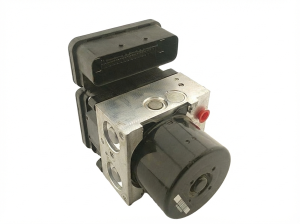
- ABS (Brake Control) Module Failure 🔴 High Probability → Shop ABS Control Module The ATE Teves MK60 ABS module used on this platform is known to fail internally. The failure is often a breakdown in the electronic control unit portion of the module, leading to a loss of communication or an internal short that disrupts the entire CAN bus network. This is a widely documented failure point.
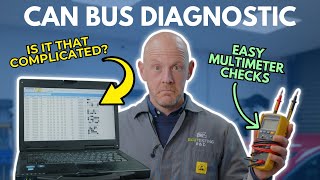
How to confirm: A technician will measure the CAN bus resistance at the OBD-II port (Pins 6 & 14). It should be ~60 Ohms. If it's incorrect (often 120 Ohms), they will disconnect the main connector from the ABS module. If the resistance across the harness pins then returns to 120 Ohms (and the resistance across the module's pins is infinite/open), the ABS module is confirmed as the faulty component. Using Volvo's VIDA software to see which modules are not communicating is also a key step.
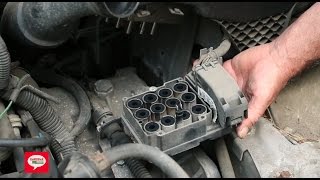
Typical fix: The most common and cost-effective solution is to remove the electronic portion of the ABS module and send it to a specialized electronics repair service (e.g., Xemodex, ACTRONICS, G7 Repair) for rebuilding. This avoids the need 🎬 See this video for the BCM removal procedure on earlier models. for expensive programming that a new module from the dealer would require. A used module may not work without a software reload from a dealer or specialist shop.
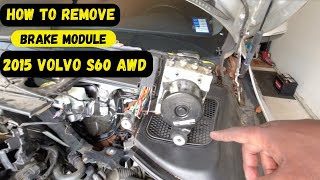
Est. part cost: $150-$400 for a rebuild service, plus labor to remove and reinstall. 🎬 Watch: Step-by-step guide to removing the ABS module on a 2015 S60.
- Central Electronic Module (CEM) Failure 🟡 Medium Probability The CEM is the central gateway for all vehicle networks. On the P3 platform, it's located in the driver's side footwell area. While less prone to water damage than on older P2 models, internal electronic failure can still occur, causing it to disrupt network communication and generate a wide array of seemingly unrelated electrical problems.
How to confirm: Diagnosis requires a Volvo-specific scan tool (VIDA) to check for communication with the CEM. If the CEM is offline and other modules are also unreachable, and the ABS module has been ruled out, the CEM is the likely suspect. A technician will check for power and ground at the CEM connectors before condemning it.
Typical fix: Similar to the ABS module, the CEM can be sent to a specialist like Xemodex for repair and cloning of the vehicle-specific software. Replacing with a used CEM is not possible without reprogramming, and a new one is very expensive.
Est. part cost: $300-$700 for a rebuild/cloning service. - Damaged Wiring or Corroded Connectors 🟡 Medium Probability The CAN bus wiring harness runs throughout the vehicle. Common problem areas include wiring near the ABS module, behind the engine, or at the main CEM connectors. Damage from chafing against the chassis or other components, previous repairs, or rodent damage can cause the CAN High and CAN Low wires to short together or to ground.
How to confirm: After confirming an incorrect resistance on the CAN bus (e.g., near 0 Ohms for a short), a technician will visually inspect known chafe points and test harness segments for continuity to pinpoint the location of the damage. This can be a very time-consuming process.
Typical fix: Repairing the damaged section of the wiring harness and ensuring it is properly protected with new conduit and routing to prevent future damage.
Est. part cost: $5-$50 for wiring repair supplies, but labor can be significant. - Low Battery Voltage or Failing Alternator ⚪ Low Probability → Shop Alternator
How to confirm: Test the battery voltage with the car off (should be >12.4V) and while running (should be ~13.5-14.5V). A simple load test on the battery is the most definitive way to confirm its health. Low voltage can cause modules to drop off the network intermittently.
Typical fix: Charge or replace the battery. If the charging voltage is low, the alternator needs to be tested and likely replaced.
Est. part cost: $150-$300 for a new battery.
Rare But Worth Checking
- Faulty Aftermarket Electronics: If a remote starter, aftermarket stereo, or telematics device was recently installed, it may have been improperly spliced into the CAN bus, causing interference. Disconnecting the device is a crucial diagnostic step.
- Faulty Steering Angle Sensor (SAS) or other CAN module: While less common, any module on the high-speed CAN bus can theoretically fail and bring down the network. The Steering Angle Sensor, part of the clockspring assembly, is another module on the network that can fail, though it's less common to cause a total network crash than the ABS module.
Technical Service Bulletins (TSBs) & Recalls
While specific to the Volvo brand's broader network architecture, several manufacturer bulletins highlight the complexity of the U0001 code. For instance, TSB Bulletin #KC-552 and TSB Bulletin #K74362312 note that the code U0001-88 can trigger the Malfunction Indicator Lamp (MIL) and potentially cause a derate warning. Additionally, TSB Bulletin #KC-433 and TSB Bulletin #K68540555 indicate that using specific diagnostic software versions, such as Bendix ACOM Version 6.14, may inadvertently cause a "Check Engine Fault" message and trigger an inactive U0001-88 code on the driver information display.
Diagnosis Steps
- Check Battery Health: Ensure the battery has a full charge (>12.4V) and test it under load. A weak battery is a common source of electronic issues.
- Scan for Codes: Use a professional, Volvo-compatible scanner (like VIDA) to read codes from ALL modules. Note which modules are not responding; this provides crucial clues. A generic scanner may only show the U0001 in the ECM.
- Check Fuses: Inspect all fuses related to the various control modules, including the CEM (in driver's footwell), ECM (engine bay), and ABS.
- Measure CAN Bus Resistance: With the key off and battery disconnected, use a multimeter to measure the resistance between Pin 6 (CAN High) and Pin 14 (CAN Low) at the OBD-II port. A healthy network will read approximately 60 Ohms.
- Interpret Resistance Reading: If the reading is ~120 Ohms, there is an open in the circuit or one of the two terminating resistors (located in the ECM and ABS module) is offline. If the reading is near 0 Ohms, the CAN High and Low wires are shorted together.
- Isolate the Fault: If the resistance is incorrect (e.g., 120 Ohms), begin disconnecting modules from the high-speed CAN bus one at a time, re-measuring resistance after each one. Start with the most likely culprit: the ABS module first. If you disconnect the ABS module and the resistance at the OBD port stays at 120 Ohms, the module is likely the source of the open circuit.
Parts You'll Likely Need
- ABS Control Module (Rebuild Service) — This is the most frequent cause of a U0001 code on this platform. The internal electronics fail, disrupting the entire network. Rebuilding is preferred over replacement to avoid dealer programming.
Trusted brands: ATE (Original Equipment)
OEM price range: $1000-$1500 (New, requires programming)
Aftermarket price range: $150-$400 (Rebuild Service) - Central Electronic Module (CEM) (Rebuild Service) — As the network gateway, an internal CEM failure can take down all communication. Like the ABS module, rebuilding is the most practical solution.
Trusted brands: Delphi (Original Equipment)
OEM price range: $1500-$2400 (New, requires programming)
Aftermarket price range: $300-$700 (Rebuild Service)
Related Codes That Often Appear With This One
- U0121 — Lost Communication With Anti-Lock Brake System (ABS) Control Module. This code often appears with U0001 when the ABS module is the specific component that has failed and brought down the network.
- U0100 — Lost Communication With ECM/PCM 'A'. This indicates the Engine Control Module is offline, a common consequence of a general CAN bus failure.
- U0101 — Lost Communication with TCM. This indicates the Transmission Control Module is offline, which explains symptoms like being stuck in gear.
- BCM-0130, BCM-0133, BCM-0136 — Brake pressure sensor fault codes. These are often stored within the ABS module itself and are a strong indicator that the module has failed internally, even if it's also causing the U0001 network code.
Mechanic-Grade Diagnostic Values
- High-Speed CAN Bus Network Resistance — expected: ~60 Ω (measured between Pin 6 and Pin 14 of the OBD-II port with battery disconnected). Failure: A reading of ~120 Ω indicates an open circuit or one terminating module is offline. A reading near 0 Ω indicates a short between the CAN High and Low wires.
- CAN High Voltage — expected: ~2.6 V (DC, measured between Pin 6 and chassis ground with ignition on). Failure: Significant deviation, 0V, or voltage matching CAN Low can indicate a short to ground or short between wires.
- CAN Low Voltage — expected: ~2.4 V (DC, measured between Pin 4 and chassis ground with ignition on). Failure: Significant deviation, 0V, or voltage matching CAN High can indicate a short to ground or short between wires.
- Terminating Resistor Resistance (at the module) — expected: ~120 Ω (measured across the module's internal CAN High and CAN Low pins when disconnected). Failure: An open or infinite resistance reading on the ABS or ECM module's pins points to an internal failure of the terminating resistor.
Hidden / Shadow Codes Worth Checking
- BCM-U000187: This is a Volvo-specific fault code from the Brake Control Module (BCM). The main code U0001 indicates a CAN bus failure, and the suffix '87' typically means 'Message Missing'. This strongly suggests the BCM itself is the source of the communication loss. (see via A Volvo-specific scanner like VIDA is required to read manufacturer-specific codes and their suffixes from individual modules.)
Scan Tool Commands That Help
- Volvo VIDA: Network Graph / Topology View — To get a visual representation of all CAN modules. Modules that are offline or 'greyed out' are not communicating, which is a primary step in isolating the fault.
- Volvo VIDA: Read Out All DTCs / Delivery Tab — This function polls every module on the vehicle for stored codes. Seeing which modules are responding and which are not is critical. The 'Delivery' tab shows active vs. inactive modules.
- VDASH or similar advanced tool: Decode CEM PIN — If the CEM is diagnosed as faulty and needs to be replaced with a used unit, the security PIN must be extracted from the original module to program the replacement. This function automates the PIN decoding process.
- OBDSTAR G3 / DC706: CEM Clone (Read/Write EEPROM and Flash) — Used by electronics specialists to perform a bench-top clone of a faulty CEM to a donor unit. This involves reading the immobilizer data, configuration, and security PIN from the original and writing it to the replacement.
Wiring & Ground Locations
- High-Speed CAN Wires — Twisted pair of wires, typically Green (CAN Low) and White (CAN High), running between the ECM, ABS, TCM, and CEM.. These are the two wires that form the network backbone. A short between them, or a short from either to ground, will cause a U0001 fault.
- Ground Point 31/4 — On the left-hand wheel housing in the engine compartment.. This is a primary ground connection for engine bay components, including the ABS module and ECM. A corroded or loose connection here can cause communication failures for those modules.
- Ground Point 31/83 — Located on the A-pillar, behind the trim on the driver's side.. This is a key ground point for components inside the passenger compartment, including the Central Electronic Module (CEM). A poor connection here can cause the CEM to malfunction.
- ABS Module Connector — On the ABS hydraulic unit, located low on the firewall, typically requiring removal of the battery and battery tray for access.. This is the primary connection point to test the ABS module. Disconnecting it is a key step in isolating the fault. Corrosion on these pins can also cause issues.
Real Owner Repair Stories
- YouTube user 'Built for Speed' (Volvo S60R (P2 Platform, but demonstrates identical ABS module failure mode)) — ABS light and brake warning light on the dash.
❌ Tried (didn't work) The owner opened the BCM (Brake Control Module) and attempted to fix it by bending the internal contact pins to make a better connection with the circuit board.
✅ What actually fixed it In a video update, the owner stated the DIY fix was not permanent and the problem returned. The final solution was to contact a professional repair service (Xemodex) to properly diagnose and repair the module.
"I Checked Everything" — The Actual Cause
- The equivalent for a network code is when resistance tests appear normal. A common scenario is an intermittent fault within the ABS module that only occurs when the module heats up during driving. A technician might measure a perfect 60 ohms at the OBD-II port when the car is cold in the garage. However, after 15 minutes of driving, the module's internal electronics fail, crashing the network. The root cause is not a wiring issue that can be easily found, but a temperature-sensitive electronic component failure inside the sealed module.
OEM Part Supersession History
30736634, 31423573→32373145— Part revision/update for the ABS Wheel Speed Sensor.
Heads up: This is for the wheel speed sensor, not the main ABS control module. For the ABS module and CEM, part numbers must be matched exactly when sourcing a used donor for cloning.
Model Year Variations Within This Range
- 2014-2018: The 2014 facelift introduced updated infotainment and electronics. Some aftermarket CAN bus adapters require different DIP switch settings for 2014+ models compared to 2011-2013 models, indicating changes in the CAN communication protocol or software that could be relevant during diagnosis with non-OEM tools.
Diagnostic Flowchart
Other Known Issues on This Vehicle
Issues unrelated to this code that are worth knowing about as an owner of this generation:
- Excessive Oil Consumption (2015-2016 Drive-E 4-Cyl & some 5-Cyl) 🔴 High — Widespread on 2015-2016 4-cylinder 'Drive-E' engines and some earlier 5-cylinder engines. Caused by faulty low-tension piston rings that get clogged with carbon. Consumption can start around 60k-80k miles and progressively worsen. (Ref: Volvo Technical Journal TJ 31233 addresses the piston ring issue for Drive-E engines, extending warranty coverage for some vehicles.)
- Clogged PCV/Oil Trap System (All Engines) 🟠 Medium — Common across all engine types, especially if oil changes are extended. The system can clog with sludge, leading to high crankcase pressure. This can cause oil leaks from cam and crank seals, a whistling noise, and increased oil consumption.
- Prematurely Worn Front Strut Mounts 🟡 Low — A very common issue across the entire P3 platform. Owners often report groaning, creaking, or popping noises from the front suspension during low-speed turns, like in parking lots. Typically requires replacement of the upper strut mounts/bearings.
- Automatic Transmission Shifting Issues 🟠 Medium → Shop Transmission Assembly — Some owners report harsh shifting, hesitation, or delayed gear engagement, particularly with the Geartronic automatic transmission. Issues can sometimes be resolved with a software update, but may also indicate internal wear or failing solenoids. (Ref: Software updates have been issued by dealers to address shift quality.)
Used vs. New Parts: Buying Guide for This Vehicle
When a used part is the smart pick: A used ABS module or Central Electronic Module (CEM) is a cost-effective option ONLY if paired with a cloning service. You must send your original faulty module and the used donor module to a specialist who will transfer the vehicle-specific programming (VIN, immobilizer data, configuration) from your old part to the used one.
What to inspect on the donor part:
- Part numbers must match EXACTLY between your original module and the donor unit.
- Verify the donor part is not from a flood or fire-damaged vehicle.
- Visually inspect connectors for any signs of corrosion or physical damage.
OEM-only on this vehicle (don't cheap out):
- Central Electronic Module (CEM)
- Brake Control Module (ABS Module)
- Engine Control Module (ECM)
Aftermarket brands forum-validated for this vehicle:
- For repair/cloning services: XeMODeX is a highly reputable brand frequently recommended on forums and by technicians.
- Other documented services include Velectronix and Automotive Circuit Solutions.
Brands owners have reported issues with on this vehicle:
- New, unbranded electronic control modules from online marketplaces. These almost never have the correct software and cannot be programmed to the vehicle, making them useless.
Related OBD-II Codes
Frequently Asked Questions
My S60's dashboard lit up with ABS, DSTC, and Check Engine lights. Is the ABS module definitely the cause of the U0001 code?
My mechanic diagnosed a bad ABS module. Can I save money by installing a used one from a junkyard?
What is the most cost-effective way to fix the failed ABS module on my 2014 Volvo S60?
A technician measured the CAN bus resistance at my OBD-II port and got a reading of 120 Ohms. What does this mean?
My 2012 S60 has this U0001 issue. Does this problem also affect the V60 or XC60 models from the same era?
Besides the ABS module, what are other potential causes for a U0001 code on this S60?
Is it worth checking my battery before paying for an expensive CAN bus diagnosis?
Helpful Videos
We Have This Part in Stock

The information in this article is provided for general reference and educational purposes only. Vehicle specifications, procedures, and part compatibility can vary by production date, trim level, and region. Always consult your vehicle's factory service manual and verify part numbers before purchasing or performing repairs. Safety-critical components such as airbags, seat belts, and braking systems should be installed by a qualified professional.
- Volvo S60:
- 🧭 Diagnostic Flowchart
- 🎬 Helpful Videos
- 🛍️ Shop This Part
- What's Unique About the 2011-2018 Volvo S60
- Symptoms You May Notice
- Most Likely Causes
- Rare But Worth Checking
- Technical Service Bulletins (TSBs) & Recalls
- Diagnosis Steps
- Parts You'll Likely Need
- Related Codes That Often Appear With This One
- Mechanic-Grade Diagnostic Values
- Hidden / Shadow Codes Worth Checking
- Scan Tool Commands That Help
- Wiring & Ground Locations
- Real Owner Repair Stories
- "I Checked Everything" — The Actual Cause
- OEM Part Supersession History
- Model Year Variations Within This Range
- Other Known Issues on This Vehicle
- Used vs. New Parts: Buying Guide for This Vehicle
- Related OBD-II Codes
- Frequently Asked Questions
- 🎟️ Get 5% Off