

C0045 on 2010-2016 Mercedes-Benz E-Class: Left Rear Wheel Speed Sensor Fixes
Code C0045 on a 2010-2016 Mercedes E-Class almost always means the left rear wheel speed (ABS) sensor has failed or its wiring is damaged. Expect to pay $40-$100 for a quality aftermarket sensor and around $150 for an OEM part. It's a common DIY repair for those comfortable removing a wheel and wheel-well liner.
- C0045 on your E-Class means there's a problem with the left rear wheel speed sensor circuit, which has disabled your ABS and ESP safety systems.
- The most likely cause is a failed sensor, which is a straightforward DIY replacement for about $40-$100.
- If a new sensor doesn't fix it, inspect the wiring harness for damage and the magnetic reluctor ring on the axle for cracks or swelling caused by rust.
- Driving is possible but risky, as emergency braking performance is significantly reduced without ABS.
What's Unique About the 2010-2016 Mercedes-Benz E-Class
The 2010-2016 E-Class (W212, S212, C207, and A207 chassis) uses a sophisticated ESP system that relies heavily on accurate data from all four wheel speed sensors. While the C0045 code itself is a standard SAE definition, its occurrence on this platform is very common and almost always points directly to a failure of the sensor itself or the wiring harness near the wheel, rather than more complex module issues. Owners on forums frequently discuss replacing these sensors as a routine maintenance item after several years of service due to their exposure to the elements. Unlike some vehicles with toothed tone rings, this E-Class generation uses a magnetic encoder ring pressed onto the axle shaft, which can also be a point of failure due to rust buildup underneath.
Generation note: The 2010-2016 year range covers the W212 (Sedan), S212 (Wagon), and the related C207/A207 (Coupe and Convertible) generations. The causes, symptoms, and repair procedures for code C0045 are consistent across these models.
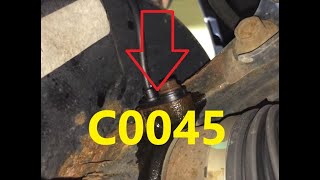
🎬 Watch: Understanding the C0045 code and how to fix it.Symptoms You May Notice
- ABS warning light illuminated on the dashboard.
- ESP (Electronic Stability Program) or traction control warning light illuminated.
- A message on the instrument cluster indicating that ABS and/or ESP are inoperative.
- Cruise control may be disabled.
- In some cases, the transmission may exhibit harsh shifting or get stuck in a low gear as a limp-home mode.
- Replacing the ABS/ESP control module before thoroughly checking the sensor, wiring, and reluctor ring. The fault is almost always at the wheel end of the circuit.
- Replacing the wheel bearing, assuming the reluctor ring is integrated, when on this platform it is typically a separate ring on the axle shaft.
Most Likely Causes
- Failed Left Rear Wheel Speed Sensor 🔴 High Probability → Shop ABS Wheel Speed Sensor The sensor is exposed to water, road salt, dirt, and constant vibration at the wheel hub, which leads to internal electronic failure over time. This is the most common point of failure for this code.
How to confirm: Using a Mercedes-specific scan tool (like Autel or iCarsoft), check the live data for all four wheel speed sensors. The left rear sensor will likely show a reading of 0 MPH or an erratic speed while the vehicle is moving, while the other three sensors report speed accurately.
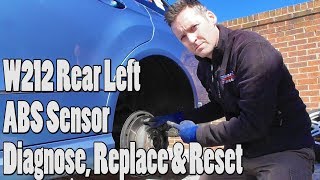
Typical fix: Replace the left rear wheel speed sensor. This involves removing the wheel, the wheel arch liner, unbolting the single sensor bolt from the hub, and disconnecting its electrical plug located behind the liner. 🎬 See this step-by-step guide to replacing the rear sensor.
Est. part cost: $40-$180 - Damaged or Corroded Wiring Harness 🟡 Medium Probability The wiring harness that runs from the sensor to the main chassis can become frayed, chafed by suspension components, or its connector pins can corrode from moisture. Rodent damage to the wiring insulation has also been reported on W212 models.
How to confirm: Visually inspect the entire length of the sensor's wiring harness for any signs of damage, especially where it passes through the suspension and into the body. Check the electrical connector for green or white corrosion. A multimeter can be used to test for continuity between the sensor connector and the ABS module connector.
Typical fix: Repair the broken wire or replace the damaged connector/pigtail. In severe cases, the entire sensor harness may need to be replaced.
Est. part cost: $10-$75 - Damaged or Contaminated Magnetic Reluctor Ring ⚪ Low Probability The sensor reads a magnetic ring (also called a tone or reluctor ring) that is pressed onto the rear axle shaft. Rust can build up underneath the ring, causing it to swell, crack, or delaminate, leading to a bad signal. This is less common than sensor failure but is a known issue.
How to confirm: After removing the wheel speed sensor, visually inspect the magnetic ring through the sensor mounting hole. Look for cracks, swelling, or heavy rust buildup. Sometimes the ring can be tested by pulling the sensor and looking down the hole while rotating the axle.
Typical fix: The damaged reluctor ring must be carefully drifted off the axle shaft and a new one pressed on. This is more involved than a sensor replacement and may require removing the axle shaft. 🎬 Watch: How to replace a damaged ABS reluctor ring. Aftermarket replacement rings are available, with some made of stainless steel to prevent future corrosion.
Est. part cost: $20-$50 for the ring, plus labor.
Rare But Worth Checking
- Faulty ABS/ESP Control Module: → Shop ABS Control Module This is the least likely cause and should only be considered after the sensor, wiring, and reluctor ring have been thoroughly tested and confirmed to be good. Module failure is expensive and rare.
Diagnosis Steps
- Connect a diagnostic scanner capable of reading Mercedes-Benz chassis codes. Confirm C0045 is present and check for any other related codes.
- Access the live data stream for the ABS/ESP module.
- Observe the wheel speed readings for all four wheels while driving slowly (under 10 mph) or spinning the wheel by hand. Confirm that the left rear wheel speed is 0, erratic, or does not match the other wheels.
- Safely raise and support the vehicle. Remove the left rear wheel.
- Remove the plastic wheel arch liner to gain access to the sensor and its wiring harness. This usually involves removing several plastic clips and screws.
- Visually inspect the sensor for physical damage and the wiring harness for any chafing, breaks, or corrosion at the connector.
- Disconnect the sensor. Use a multimeter to test the wiring for continuity back to the ABS module. Check for proper voltage and ground at the connector if specifications are available.
- Remove the single bolt holding the ABS sensor and pull the sensor out of the wheel hub. Inspect the sensor tip for damage or metallic debris.
- With the sensor removed, use a flashlight to inspect the magnetic reluctor ring on the axle shaft for cracks, swelling due to rust, or other visible damage.
- If the sensor is determined to be faulty, replace it. If the wiring is damaged, repair it. If the reluctor ring is cracked or swollen, it must be replaced. In rare cases where all components test good, the ABS module itself may be the issue.
Parts You'll Likely Need
- Left Rear Wheel Speed Sensor (ABS Sensor)
(OEM #A2075400317 (Note: Part numbers can vary by specific model/year, always verify with VIN))— This is the most common failure point for code C0045 due to its exposed location and electronic nature.
Trusted brands: Bosch, ATE, Continental, VEMO, NTK
OEM price range: $120-$180
Aftermarket price range: $40-$100 - Rear ABS Reluctor Ring
(OEM #A2303570182)— The second most likely hardware failure. Rust can cause the original ring to crack or swell, disrupting the magnetic signal the sensor needs to read.
Trusted brands: OE Improved, Febi, Meyle
OEM price range: N/A (Often sold with axle)
Aftermarket price range: $20-$50
Platform-Specific Known Issues
- Reluctor Ring Swelling/Cracking: Unlike many cars where the tone ring is part of the wheel bearing, on the W212/C207 it is a separate ring pressed onto the axle shaft. It is known to corrode, swell, and crack, which pushes it into the sensor or disrupts the signal. This is a common failure mode after the sensor itself.
Documented NHTSA Reports
While the C0045 code is frequently a sensor or ring issue on Mercedes-Benz vehicles, cross-manufacturer records provide additional context on how this fault manifests. For instance, NHTSA ODI #11219167 describes a case where a C0045 code was triggered by a broken left rear wheel speed sensor encoder ring, requiring replacement of both the sensor and the hub assembly. Similarly, NHTSA ODI #11165895 notes that service centers may report C0045 as a need to replace the hub bearing assembly, although solutions can vary. In some instances, as seen in NHTSA ODI #10382746, the code may appear alongside other faults like C0057 or C0231, leading manufacturers to recommend software re-programming. Furthermore, NHTSA ODI #11399819 highlights that C0045 can occasionally appear in conjunction with fuel system codes like P0463 and P069E, though this is less common for the E-Class platform.
Mechanic-Grade Diagnostic Values
- Active Sensor Supply Voltage — expected: 10.5V - 12V DC. Failure: No voltage or significantly low voltage indicates a wiring or ABS module issue.
- Active Sensor Signal (Multimeter) — expected: Voltage should switch rapidly between a low value (e.g., ~0.7V) and a high value (e.g., ~1.4V) as the wheel is spun. A static voltage or no change indicates a faulty sensor or reluctor ring.. Failure: No voltage fluctuation while spinning the wheel.
- Active Sensor Signal (Oscilloscope) — expected: A clean digital square wave that increases in frequency as the wheel spins faster.. Failure: A missing, erratic, or distorted waveform points to a faulty sensor, damaged reluctor ring, or excessive air gap.
Hidden / Shadow Codes Worth Checking
- C0045 with detail text: A Mercedes-specific scanner like XENTRY may provide additional text, such as 'The signal from component L6/3 (Left rear axle rpm sensor) is faulty' or 'implausible'. This confirms the fault location but doesn't distinguish between sensor, wiring, or ring. (see via Mercedes-Benz XENTRY/DAS diagnostic system or a high-end professional scanner (iCarsoft, Autel) with Mercedes software.)
Scan Tool Commands That Help
- XENTRY/DAS: Guided Tests — When diagnosing a C0045, XENTRY can provide a step-by-step diagnostic plan, prompting the technician to check specific values and components in a logical order.
- Professional Scan Tool (iCarsoft, Autel, etc.): Live Data > ESP/ABS Module > Wheel Speed Sensors — This is the primary and first diagnostic step. Observing the live data from all four sensors while driving or spinning the wheel is the fastest way to confirm which sensor is providing an incorrect signal.
Wiring & Ground Locations
- N30/4 — The ESP (Electronic Stability Program) control unit is typically integrated with the ABS hydraulic unit in the engine bay, on the driver's side.. This module receives the signals from all four wheel speed sensors. In rare cases of failure, or more commonly for testing wiring continuity, you would need to access its main connector.
- W16/4 — A key ground point located in the engine bay, often under or near the battery tray in the 'wheelhouse' area.. A poor ground at this location can cause various electrical issues, including erratic behavior from control modules like the ESP/ABS unit. While not a direct cause of a single sensor code, checking major grounds is good practice for any electrical fault.
- ABS/ESP Module Connector Pins — At the N30/4 module connector.. For a W212 before model year 2013, pins 13 and 38 are the main grounds (T31) for the module. Checking continuity and voltage at these pins can rule out a module power or ground issue.
Real Owner Repair Stories
- MBWorld.org Forums (2014 Mercedes E550) — ABS and other warning lights on the dash. Scan tool showed a faulty right rear wheel speed sensor with a pegged reading of over 40,000 mph, even when stationary.
❌ Tried (didn't work) The reading remained pegged whether the sensor was installed, unplugged, or plugged in but outside the hub.
✅ What actually fixed it The owner deduced the issue was the magnetic reluctor ring on the axle shaft. Clearing the code would temporarily show 0 mph, and moving a new ring near the sensor would generate a plausible speed reading, confirming the sensor and wiring were likely good and the ring on the car was the problem. - Mercedes-Benz Owners' Forums (Mercedes W212) — ABS, ESP, and Run Flat Inoperative warnings appeared immediately after an independent shop replaced a front wheel bearing.
❌ Tried (didn't work) The mechanic was unsure of the cause.
✅ What actually fixed it The issue was an incorrect aftermarket wheel bearing seal. The kit came with a seal that did not have the correct integrated magnetic reluctor ring. Replacing the incorrect seal with a genuine Mercedes-Benz part resolved all the warning lights.
OEM Part Supersession History
A2303570182 (Reluctor Ring)→No official supersession, but aftermarket alternatives exist.— The OEM design is prone to rusting, which causes it to swell and crack.
Heads up: Many aftermarket reluctor rings are now made from stainless steel or have improved coatings to prevent the common rust/swelling failure mode. Choosing a stainless steel version is a common upgrade to prevent repeat failures.
Diagnostic Flowchart
Other Known Issues on This Vehicle
Issues unrelated to this code that are worth knowing about as an owner of this generation:
- Premature Engine and Transmission Mount Failure 🟠 Medium → Shop Transmission Assembly — Very common after 60,000-80,000 miles. The fluid-filled mounts collapse, causing excessive vibration at idle, in gear, and clunking noises.
- M276 V6 Engine - Cold Start Rattle / Camshaft Adjuster Issues 🟠 Medium — Common on early M276 engines (pre-2014). A rattle on cold startup is caused by oil pressure bleed-down in the timing chain tensioners. The fix involves installing updated tensioners and check valves. Ignoring it can lead to camshaft adjuster failure. (Ref: Multiple TSBs exist regarding the installation of check valves and updated tensioners.)
- OM651 Diesel Engine - Injector Seals, Timing Chain, Leaks 🔴 High — The 2.1L 4-cylinder diesel has several known issues, including leaking injector seals ('black death'), timing chain stretch, and oil/coolant leaks from the oil cooler or water pump.
- Fading Burl Walnut Wood Trim 🟡 Low — Extremely common across all years. The burl walnut wood trim (option code 731) has inadequate UV protection and is known to fade, discolor, or become cloudy over time. (Ref: A class-action lawsuit resulted in a settlement offering extended warranty coverage for replacement, which went into effect in January 2023.)
- 722.9 Transmission - Turbine Speed Sensor Failure 🟠 Medium → Shop Transmission Assembly — Can occur on higher mileage vehicles, causing harsh shifting, delayed engagement, or the transmission going into limp mode. The failure is often the sensor on the conductor plate inside the transmission.
- Front Suspension Thrust Link Bushing Wear 🟡 Low — The bushings on the front forward thrust links can crack and separate, leading to uneven inner tire wear and a slight clunking over bumps.
Used vs. New Parts: Buying Guide for This Vehicle
When a used part is the smart pick: A used wiring harness pigtail from a junkyard is a viable option if only the connector is damaged and the rest of the harness is intact. It is not recommended to buy used electronic sensors or wear items like reluctor rings.
Donor-vehicle mileage cap: roughly under 100000 miles for the part to have meaningful remaining life.
What to inspect on the donor part:
- For a wiring pigtail, inspect for any signs of corrosion (green or white powder) on the pins.
- Ensure the plastic connector housing is not brittle or cracked.
- Check that the wire insulation is flexible and not hardened or frayed.
OEM-only on this vehicle (don't cheap out):
- No parts for this repair are strictly 'OEM-only', but using high-quality OE-supplier brands is highly recommended to avoid premature failure.
Aftermarket brands forum-validated for this vehicle:
- Sensors: Bosch, ATE, Continental, NTK.
- Reluctor Rings: Febi, Meyle, or any brand explicitly offering a stainless steel version.
Brands owners have reported issues with on this vehicle:
- Unbranded, 'white-box' sensors from online marketplaces are frequently reported by owners to be dead-on-arrival or fail within a few months.
Real Owner Stories
Aggregated from forums and TSBs cited above. Mileages and costs reflect what owners reported in those sources.
2014 Mercedes-Benz E-Class (W212)
Symptoms: ABS/ESP/Etc. lights on, but no codes initially visible on a generic scanner.
What fixed it: Replacing the left rear wheel speed sensor.
Source hint: MBWorld.org - "ABS/ESP/Etc. lights on, but no codes"
2012 Mercedes-Benz E-Class (W212)
Symptoms: ABS warning light and ESP inoperative message; cruise control disabled.
What fixed it: Replacing the left rear wheel speed sensor after confirming 0 MPH reading on live data.
Source hint: MBWorld.org Forums
2013 Mercedes-Benz E-Class (W212)
Symptoms: The magnetic ring on the axle shaft was pushed into the sensor due to rust swelling.
What fixed it: The damaged reluctor ring was drifted off the axle shaft and a new one was pressed on.
Source hint: vehicle_specific_issues - Reluctor Ring Swelling/Cracking
Related OBD-II Codes
Frequently Asked Questions
My 2012 E-Class is showing ABS and ESP inoperative messages; could this be related to the wood trim settlement?
Is the C0045 code on my W212 E-Class caused by the same part as the CLS-Class?
Can a faulty wheel speed sensor cause my E-Class transmission to shift harshly?
I've replaced the sensor but the code persists; is there a known issue with the axle itself?
Are there any TSBs for engine rattles that might be confused with chassis codes like C0045?
How can I confirm if the left rear sensor is actually the problem on my Mercedes?
Helpful Videos

We Have This Part in Stock




The information in this article is provided for general reference and educational purposes only. Vehicle specifications, procedures, and part compatibility can vary by production date, trim level, and region. Always consult your vehicle's factory service manual and verify part numbers before purchasing or performing repairs. Safety-critical components such as airbags, seat belts, and braking systems should be installed by a qualified professional.
- Mercedes-Benz E-Class:
- 🧭 Diagnostic Flowchart
- 🎬 Helpful Videos
- 🛍️ Shop This Part
- What's Unique About the 2010-2016 Mercedes-Benz E-Class
- Symptoms You May Notice
- Most Likely Causes
- Rare But Worth Checking
- Diagnosis Steps
- Parts You'll Likely Need
- Platform-Specific Known Issues
- Documented NHTSA Reports
- Mechanic-Grade Diagnostic Values
- Hidden / Shadow Codes Worth Checking
- Scan Tool Commands That Help
- Wiring & Ground Locations
- Real Owner Repair Stories
- OEM Part Supersession History
- Other Known Issues on This Vehicle
- Used vs. New Parts: Buying Guide for This Vehicle
- Real Owner Stories
- 2014 Mercedes-Benz E-Class (W212)
- 2012 Mercedes-Benz E-Class (W212)
- 2013 Mercedes-Benz E-Class (W212)
- Related OBD-II Codes
- Frequently Asked Questions
- 🎟️ Get 5% Off