

P0502 on 2011-2023 Dodge Charger: Causes and Fixes for Vehicle Speed Sensor Low Input
On a 2011-2023 Dodge Charger, code P0502 is almost always caused by a faulty wheel speed sensor or its wiring. Expect to pay $25-$75 for an aftermarket sensor and spend about an hour replacing it. Always check for ABS codes first, as they will pinpoint which wheel is the problem.
- P0502 on a 2011-2023 Charger points to a problem in the wheel speed sensor system, not a transmission sensor.
- The most likely cause is a single failed wheel speed sensor.
- Always check for ABS codes with a capable scanner first; this will usually tell you exactly which wheel to inspect.
- Symptoms include a dead speedometer and disabled ABS/Traction Control systems.
- The fix is usually a DIY-friendly replacement of the faulty sensor, which is held in by one bolt.
What's Unique About the 2011-2023 Dodge Charger
Unlike older vehicles that used a single Vehicle Speed Sensor (VSS) on the transmission, the 2011-2023 Charger relies on its ABS wheel speed sensors to determine how fast the car is moving. The P0502 code is often accompanied by ABS or traction control warning lights. Therefore, diagnosing this code on a Charger almost always begins with investigating the ABS system, not looking for a traditional VSS on the transmission case. The PCM expects a square-wave voltage from the sensor that changes with wheel rotation; a persistent low voltage near zero triggers the code.
Generation note: The 2011-2023 Dodge Charger is one generation (LD), but it received a major facelift for the 2015 model year. The underlying ABS and wheel speed sensor system that causes code P0502 is fundamentally the same across this entire year range. However, part numbers for the wheel speed sensors may differ between the 2011-2014 and 2015-2023 models, so it's crucial to verify with your VIN.
Symptoms You May Notice
- Check Engine Light is on
- ABS and/or Traction Control (ESC) warning lights are on
- Speedometer reads 0 MPH or is erratic
- Cruise control will not engage
- Transmission shifts harshly or at incorrect times
- Odometer may not accumulate mileage
- Replacing the transmission output speed sensor. While some vehicles have this, the Charger in this year range primarily uses wheel speed sensors for the vehicle speed signal reported to the PCM.
Most Likely Causes
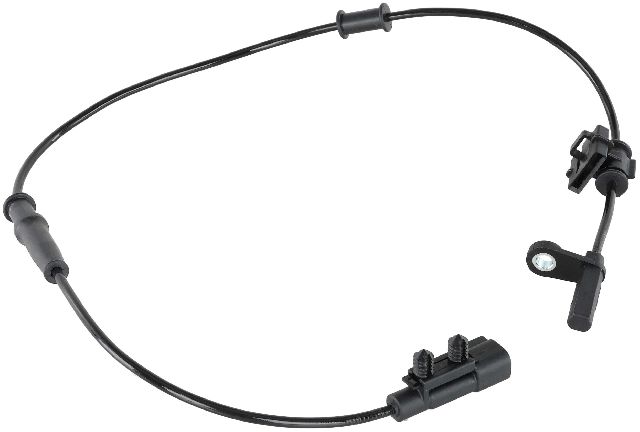
- Faulty Wheel Speed Sensor 🔴 High Probability → Shop ABS Wheel Speed Sensor The sensors are exposed to road debris, water, and heat at the wheel hubs, leading to failure over time. The internal magnetic sensor element can fail or short to ground.
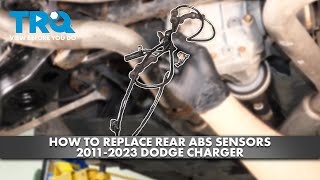
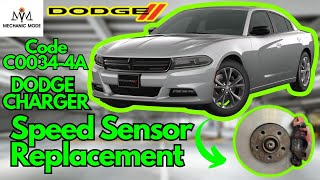
How to confirm: Scan the ABS control module for codes. A code like C0031, C0034, C0037, or C0040 will point to a specific wheel sensor (Left Front, Right Front, Left Rear, Right Rear). You can also use a scan tool to watch the live data from all four sensors while driving; the faulty sensor will read 0 or have an erratic signal. Sensors can become seized in the knuckle; using penetrating oil and gently twisting can help with removal. 🎬 See this step-by-step rear ABS sensor replacement walkthrough
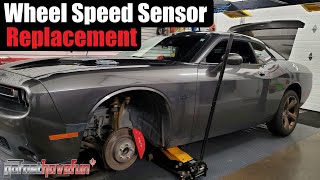
Typical fix: Replace the faulty wheel speed sensor. The sensor is typically held into the steering knuckle or rear hub assembly by a single 10mm bolt. 🎬 Watch: Quick front wheel speed sensor replacement guide
Est. part cost: $25-$75 - Damaged Wheel Speed Sensor Wiring or Connector 🟡 Medium Probability → Shop ABS Wheel Speed Sensor The wiring harness runs down the suspension and is susceptible to being stretched, chafed by suspension components, or damaged by road debris. The connector can also fill with dirt or corrode, causing a poor connection.
How to confirm: Visually inspect the wiring harness from the back of the wheel hub up into the wheel well. Look for any signs of breaks, chafing, or melted plastic. Disconnect the sensor and check the connector pins for corrosion or damage. Perform a 'wiggle test' on the harness while monitoring the sensor signal on a scan tool to see if the reading cuts out.
Typical fix: Repair the damaged section of wire or replace the connector pigtail. In severe cases, the entire sensor harness may need replacement.
Est. part cost: $15-$50 - Damaged or Debris-Covered Tone Ring ⚪ Low Probability The tone ring, which is part of the wheel hub/bearing assembly, can accumulate metallic debris or rust, obstructing the sensor's magnetic reading. While less common, a damaged tooth on the ring can cause an erratic signal.
How to confirm: When the wheel speed sensor is removed, visually inspect the toothed tone ring inside the hub. Check for broken teeth, heavy rust, or a buildup of metallic grime.
Typical fix: Cleaning the tone ring may work temporarily, but if it is damaged, the entire wheel hub and bearing assembly must be replaced.
Est. part cost: $100-$250
Rare But Worth Checking
- Faulty ABS Control Module: → Shop ABS Control Module This is rare. Before condemning the module, exhaust all other possibilities. This is typically indicated if there are no signals from multiple sensors and all wiring has been confirmed to be good.
- Faulty Powertrain Control Module (PCM): → Shop Engine Control Module (ECM) Extremely rare. The PCM is the last item to suspect. All other diagnostic steps for sensors, wiring, and the ABS module must be completed first.
Diagnosis Steps
- Scan for Codes: Use an OBD-II scanner that can read codes from the ABS module. Note any codes present in the PCM and ABS systems.
- Prioritize ABS Codes: If any wheel-specific sensor codes (C0031, C0034, etc.) or communication codes (U0121) are present, diagnose them first.
- Inspect the Suspect Sensor and Wiring: Based on the ABS codes, locate the corresponding wheel speed sensor. Visually inspect the sensor, its connector, and the wiring harness for any obvious damage, corrosion, or chafing.
- Monitor Live Data: Use a capable scan tool to view the live data stream for all four wheel speed sensors. Drive the vehicle slowly or spin the wheels by hand (with the vehicle safely on jack stands). All sensors should report a similar speed. The sensor that reads 0 MPH or has an erratic signal is the likely culprit.
- Test the Circuit: If the sensor appears good, disconnect its connector. Check for the correct reference voltage (typically 11-12V DC) and a good ground at the harness connector using a multimeter.
- Test/Replace the Sensor: If the wiring provides correct voltage and ground, the sensor itself is the most likely cause of the problem. Replacing it is often the most straightforward next step.
Parts You'll Likely Need
- Wheel Speed Sensor
(OEM #Front Right (2011-14): 5105572AA; Front Left (2011-14): 5105573AA/5105573AB; Rear (2015-23): 68067792AA; Front (2015-23): 68088592AA (Part numbers vary by year/drivetrain, always confirm with VIN))— This is the most common component to fail, causing a loss of signal and triggering the P0502 code.
Trusted brands: Mopar, Bosch, NTK, Standard Motor Products (SMP)
OEM price range: $60-$120
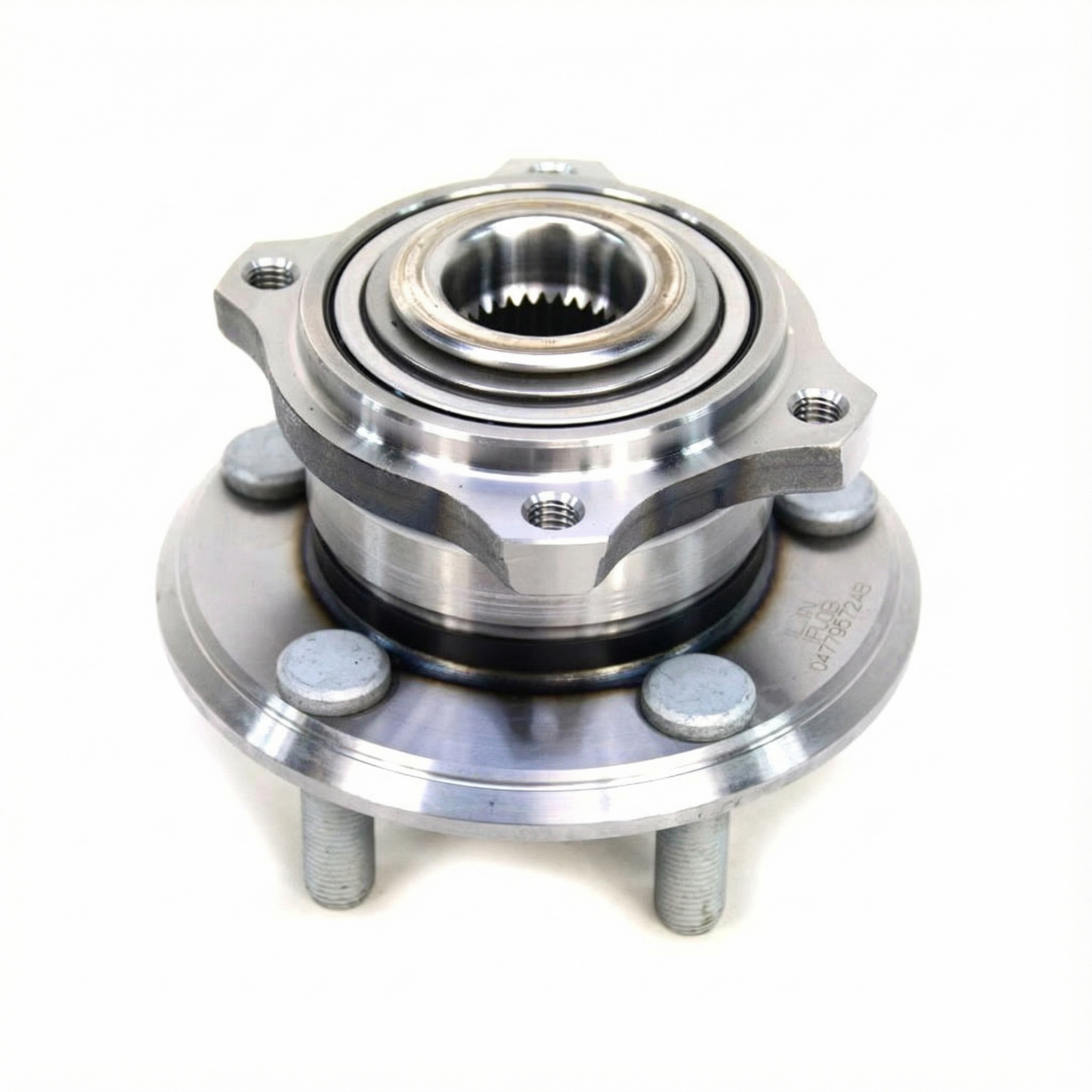
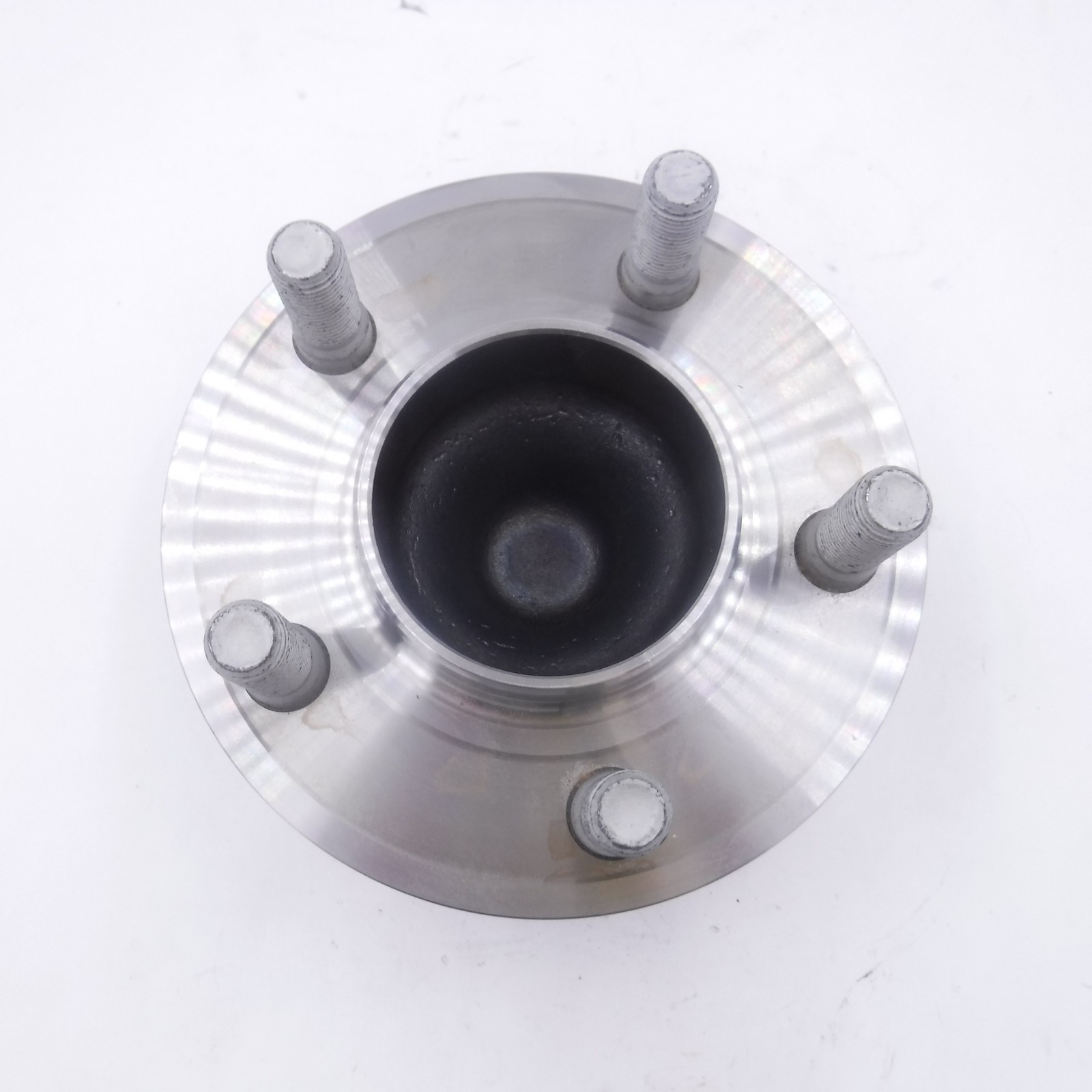
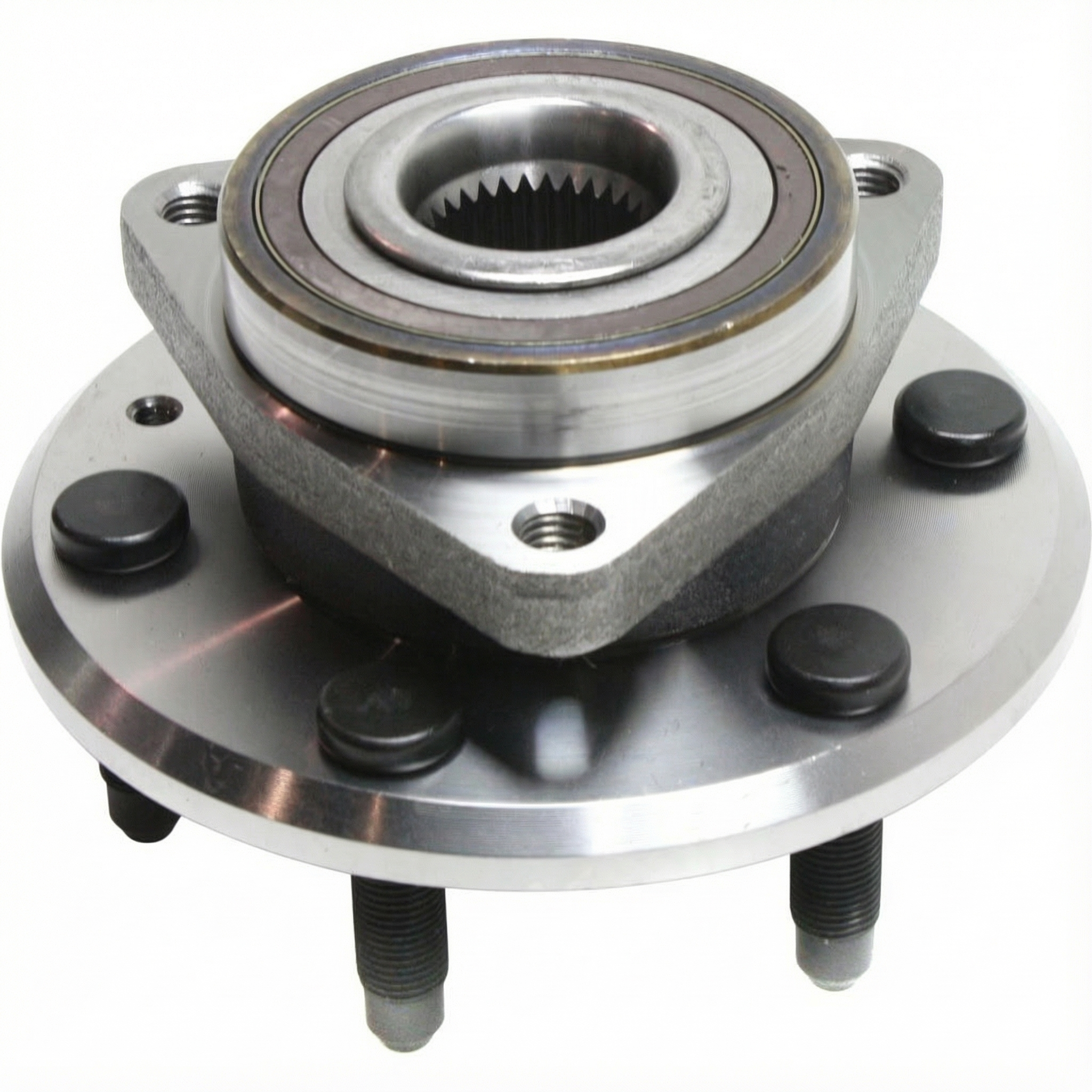
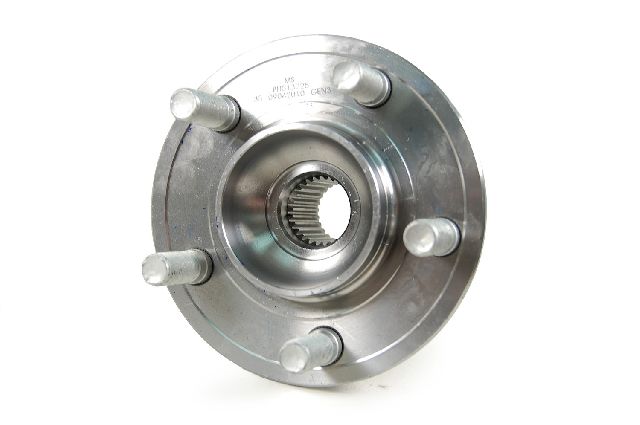
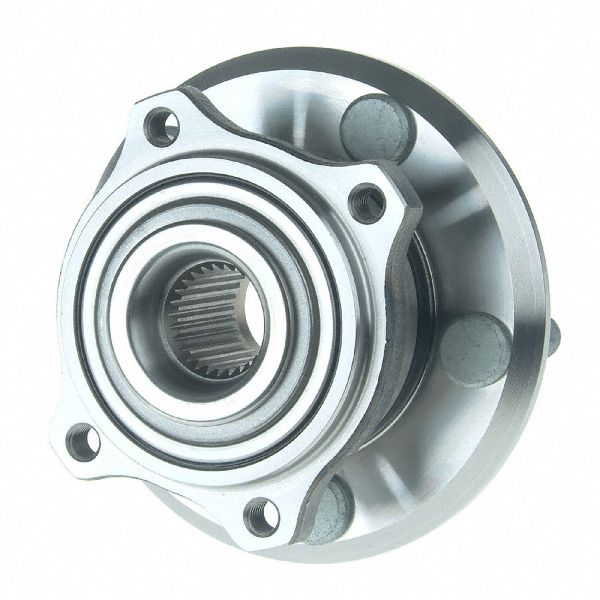
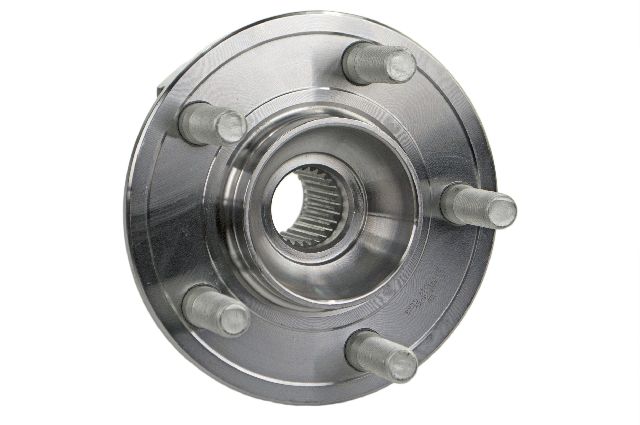
Aftermarket price range: $25-$75 - Wheel Hub and Bearing Assembly — This part is replaced if the integrated tone ring is damaged or if the bearing itself has failed, causing damage to the sensor.
Trusted brands: Mopar, Timken, MOOG, SKF
OEM price range: $200-$350
Aftermarket price range: $100-$250
Related Codes That Often Appear With This One
- U0121 — This code means 'Lost Communication With ABS Module'. If the PCM can't communicate with the ABS module, it won't get a vehicle speed signal, triggering P0502. U0121 should be diagnosed first.
- C0031-C0040 — These are ABS codes that correspond to specific wheel speed sensor circuits. They are extremely helpful in pinpointing which sensor or circuit is causing the P0502 code.
Technical Service Bulletins (TSBs) & Recalls
- TSB 08-049-20 (NHTSA ID 10175735): Addresses intermittent loss of communication with various modules, which could be a related diagnostic path if U-codes are also present.
- TSB 9100226 (NHTSA ID 10244348): General TSB regarding connector repair kits, relevant if a damaged wheel speed sensor connector is found.
Mechanic-Grade Diagnostic Values
- Active Wheel Speed Sensor Supply Voltage — expected: Approximately 11-12 Volts DC with the key on, engine off, measured at the harness-side connector for the wheel speed sensor.. Failure: A reading of 0 volts indicates a problem with the wiring, ABS fuse, or the ABS module itself.
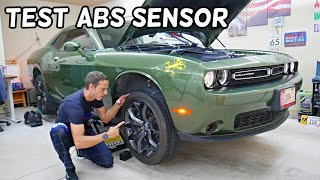
- Active Wheel Speed Sensor Signal Fluctuation — expected: While monitoring the DC supply voltage with the sensor connected, spinning the wheel by hand should cause the voltage to fluctuate slightly.. Failure: If supply voltage is present but does not change at all while the wheel is spinning, the sensor itself is likely faulty. 🎬 Watch: How to test a Dodge wheel speed sensor with a multimeter
Scan Tool Commands That Help
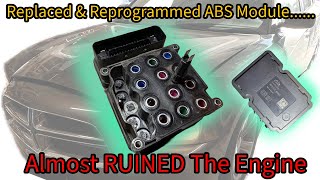
- wiTECH or equivalent professional scanner (e.g., Autel): ABS Initialization / Initialize ABS Module — This function is mandatory after replacing the ABS control module. The new module must be programmed with the vehicle's VIN and calibrated to its specific systems. Failure to perform this step will result in a persistent ABS light and non-functional system, often with codes like C2200.
- wiTECH or equivalent professional scanner: G Sensor Calibration — This is often a sub-procedure within the main ABS Initialization. It calibrates the yaw rate / dynamics sensor. A failure during this step can leave a traction control light on even if the ABS light is off.
- wiTECH or equivalent professional scanner: Live Data > Wheel Speed Sensors — This is the primary method to confirm a faulty sensor. By driving the vehicle slowly (or spinning the wheels on a lift), a technician can observe the speed reading from all four sensors simultaneously. The sensor that reads 0 MPH or shows an erratic signal compared to the others is the one with the fault.
Wiring & Ground Locations
- Wheel Speed Sensor Connector — The sensor is bolted to the steering knuckle (front) or rear hub assembly. The harness connector is typically located just behind the fender liner.. This connector is a common point for corrosion or damage, which interrupts the signal and causes code P0502.
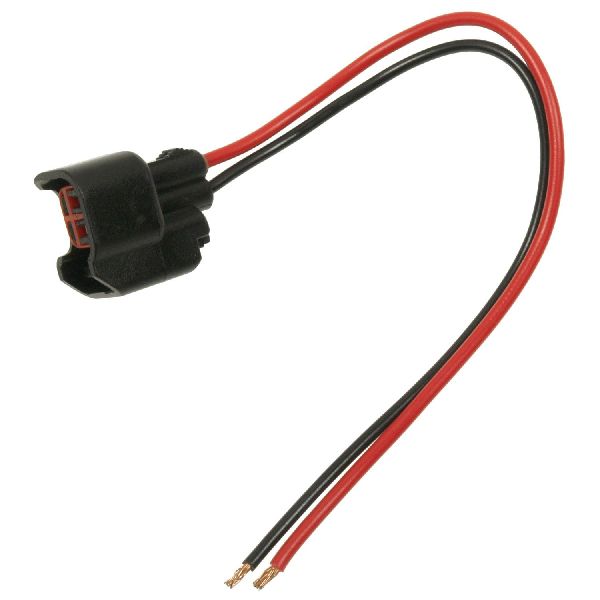
- Sensor Connector Pins (2-wire active sensor) — At the harness-side connector for any of the four wheel speed sensors.. One pin is the voltage supply from the ABS module (approx. 12V), and the other is the signal return. Testing for voltage here is a key diagnostic step to differentiate a sensor failure from a wiring or module failure.
Real Owner Repair Stories
- YouTube channel 'Another Lap' (2013 Dodge Charger SE 3.6L) — ABS light on, codes C2200, C2202, C2206 (ABS module internal faults).
❌ Tried (didn't work) Initially, just replacing the ABS module did not solve the problem.
✅ What actually fixed it The ABS module was replaced, but the critical step was using an Autel bidirectional scanner to perform the 'ABS Initialization' routine. The process ran into a 'G sensor calibration error' but after retrying, it successfully programmed the module, clearing the main ABS fault codes. This highlights that part replacement is only half the job; software calibration is required. - YouTube channel 'Auto Repair Guys' (2018 Dodge Challenger (platform mate)) — ABS and traction control lights on.
❌ Tried (didn't work) Guessing which sensor was bad.
✅ What actually fixed it The technician used a bidirectional scan tool to view the 'Live Data' for all four wheel speed sensors while the vehicle was raised and the wheels were spun by hand. This immediately showed one sensor was not reporting a speed, confirming exactly which corner had the fault without any guesswork. - Online article/forum post (2014 Dodge Charger 3.6L V6) — Persistent ABS light and wheel speed sensor codes.
❌ Tried (didn't work) Installing an aftermarket wheel speed sensor that was listed as compatible for 'all Chargers'.
✅ What actually fixed it The aftermarket sensor did not work and continued to show erratic signals. The problem was only resolved by installing the specific OEM part number (68199987AC/AB). This confirmed that not all aftermarket parts are electronically compatible, even if they physically fit.
When the Usual Fixes Don't Work
- While a faulty wheel speed sensor is the most common cause, simply swapping the part may not fix the issue. In one documented case, an owner used an aftermarket sensor that was advertised to fit but was electronically incompatible, and the code did not clear until a specific OEM part was used. In another case involving a rare ABS module failure, replacing the module hardware was insufficient; the fix required a professional scan tool to perform an 'ABS Initialization' procedure to marry the new module to the car, a step often missed by DIYers.
OEM Part Supersession History
4779647ab, 4779647ac, 4779647ad, 4779647ae→04779647AF— Part revision and consolidation by the manufacturer.
Heads up: This applies to a specific rear sensor for RWD models, often with performance brake options. Always verify the correct part number for your specific VIN.
Model Year Variations Within This Range
- 2011-2023: The 'ABS Initialization' procedure required after module replacement may differ. Some earlier models require a road test with specific 90-degree turns to calibrate, while some later models (approx. 2018+) may complete the entire calibration process while stationary.
- 2011-2014 vs 2015-2023: Front and rear wheel speed sensor part numbers are often different between the pre-facelift (2011-2014) and post-facelift (2015-2023) models. Using a sensor from the wrong year range will likely result in an 'Incorrect Component Installed' fault.
Diagnostic Flowchart
Other Known Issues on This Vehicle
Issues unrelated to this code that are worth knowing about as an owner of this generation:
- 3.6L Pentastar V6 Lifter/Rocker Arm Failure ('Pentastar Tick') 🔴 High — Common on 2014-2020 models, typically appearing after 60,000 miles. A class-action lawsuit was filed regarding this issue. The failure of needle bearings in the rocker arms leads to a distinct ticking noise and can cause camshaft damage if ignored. (Ref: TSB #9100229 (NHTSA ID 10244356) exists for deactivating MDS lifters, but no recall addresses the primary failure.)
- Uconnect 8.4-inch Screen Delamination and 'Ghost Touch' 🟠 Medium — Widespread on models from approx. 2017-2022. The adhesive between the screen layers fails, causing bubbling and phantom screen presses. Often occurs 1-3 years into ownership. (Ref: No recall, but many owners report dealers replacing units under warranty or with goodwill adjustments. Aftermarket screen/digitizer assemblies are a common DIY fix.)
- ZF 8-Speed (8HP) Transmission Shudder or Harsh Shifts 🟠 Medium → Shop Transmission Assembly — Can occur at various mileages. Issues range from software needing an update to internal valve body wear or torque converter problems. Chrysler's 'lifetime fluid' recommendation is debated, with many specialists recommending fluid changes around 60,000-80,000 miles to prevent issues. (Ref: Various software update TSBs have been issued to address shift quality.)
- Alternator Failure 🔴 High — Particularly noted on earlier models (approx. 2011-2014). Failure can be sudden and completely disable the vehicle. A recall was issued for certain models. (Ref: Recall NHTSA #14V634000 for 160-amp and 180-amp alternators on 2011-2014 models.)
- Front Lower Control Arm Bushing Noise 🟡 Low — A squeaking or rattling noise from the front suspension over bumps is common. It is usually caused by worn lower control arm bushings. (Ref: TSB #0200523 (NHTSA ID 10242808) addresses this issue, involving inspection and possible replacement of the control arms.)
Used vs. New Parts: Buying Guide for This Vehicle
When a used part is the smart pick: For this repair, a used part is only potentially sensible for the ABS Control Module, as new OEM units can be expensive. However, this is a rare failure. Used wheel speed sensors are not recommended.
Donor-vehicle mileage cap: roughly under 80000 miles for the part to have meaningful remaining life.
What to inspect on the donor part:
- For a used ABS Module, ensure the part number is an exact match.
- Verify the donor vehicle was not in a flood or major collision.
- Ask for a warranty from the salvage yard if possible.
OEM-only on this vehicle (don't cheap out):
- While not strictly 'OEM-only', using an OEM wheel speed sensor is highly advisable if an initial replacement with a reputable aftermarket brand fails to solve the code. Incompatibilities are a known issue on this platform.
Aftermarket brands forum-validated for this vehicle:
- NTK
- Bosch
- Standard Motor Products (SMP)
- Dorman
- Delphi
- Holstein
Brands owners have reported issues with on this vehicle:
- Unbranded, 'white-box' parts from online marketplaces have a higher risk of electronic incompatibility, even if they are advertised to fit.
Real Owner Stories
Aggregated from forums and TSBs cited above. Mileages and costs reflect what owners reported in those sources.
2013 Dodge Charger
Symptoms: Owner experienced P0502 with ABS/ESC lights on.
What fixed it: Replacing the left rear wheel speed sensor after getting a specific ABS code (C0037) with a better scanner.
Source hint: ChargerForums.com thread titled 'P0502 and ABS/ESC lights on my 2013 Charger'
2011-2023 Dodge Challenger
Symptoms: The speedometer quit working and the vehicle threw a P0502 code.
What fixed it: Replacing the rear left wheel speed sensor.
Source hint: ChallengerTalk.com thread titled 'Speedometer died, P0502 code'
Related OBD-II Codes
Frequently Asked Questions
My 2013 Charger has P0502 and the ABS/ESC lights are on. Is there a specific sensor I should check?
Is there a TSB for the wiring connectors if I find corrosion while diagnosing P0502?
Could my P0502 code be related to the 'intermittent loss of communication' issues I've heard about on Chargers?
My speedometer reads 0 MPH and I have a P0502. Does this mean I need a new transmission?
Can I use parts from a Chrysler 300 or Dodge Challenger to fix this on my Charger?
I'm also hearing a ticking noise from my 3.6L engine; could this be related to the P0502 code?
Helpful Videos
Used OEM Parts in Stock
New Aftermarket Parts Available


The information in this article is provided for general reference and educational purposes only. Vehicle specifications, procedures, and part compatibility can vary by production date, trim level, and region. Always consult your vehicle's factory service manual and verify part numbers before purchasing or performing repairs. Safety-critical components such as airbags, seat belts, and braking systems should be installed by a qualified professional.
- Dodge Charger:
- 🧭 Diagnostic Flowchart
- 🎬 Helpful Videos
- 🛍️ Shop This Part
- What's Unique About the 2011-2023 Dodge Charger
- Symptoms You May Notice
- Most Likely Causes
- Rare But Worth Checking
- Diagnosis Steps
- Parts You'll Likely Need
- Related Codes That Often Appear With This One
- Technical Service Bulletins (TSBs) & Recalls
- Mechanic-Grade Diagnostic Values
- Scan Tool Commands That Help
- Wiring & Ground Locations
- Real Owner Repair Stories
- When the Usual Fixes Don't Work
- OEM Part Supersession History
- Model Year Variations Within This Range
- Other Known Issues on This Vehicle
- Used vs. New Parts: Buying Guide for This Vehicle
- Real Owner Stories
- 2013 Dodge Charger
- 2011-2023 Dodge Challenger
- Related OBD-II Codes
- Frequently Asked Questions
- 🎟️ Get 5% Off